
Goals that cannot be measured
When plans are written without measurable targets, there is no way to know if student outcomes actually improved.
One connected intervention ecosystem
TriaED connects district priorities, school teams, educators, interventions, progress monitoring, and student engagement in one ecosystem — ensuring every piece of data leads directly to targeted, actionable support.
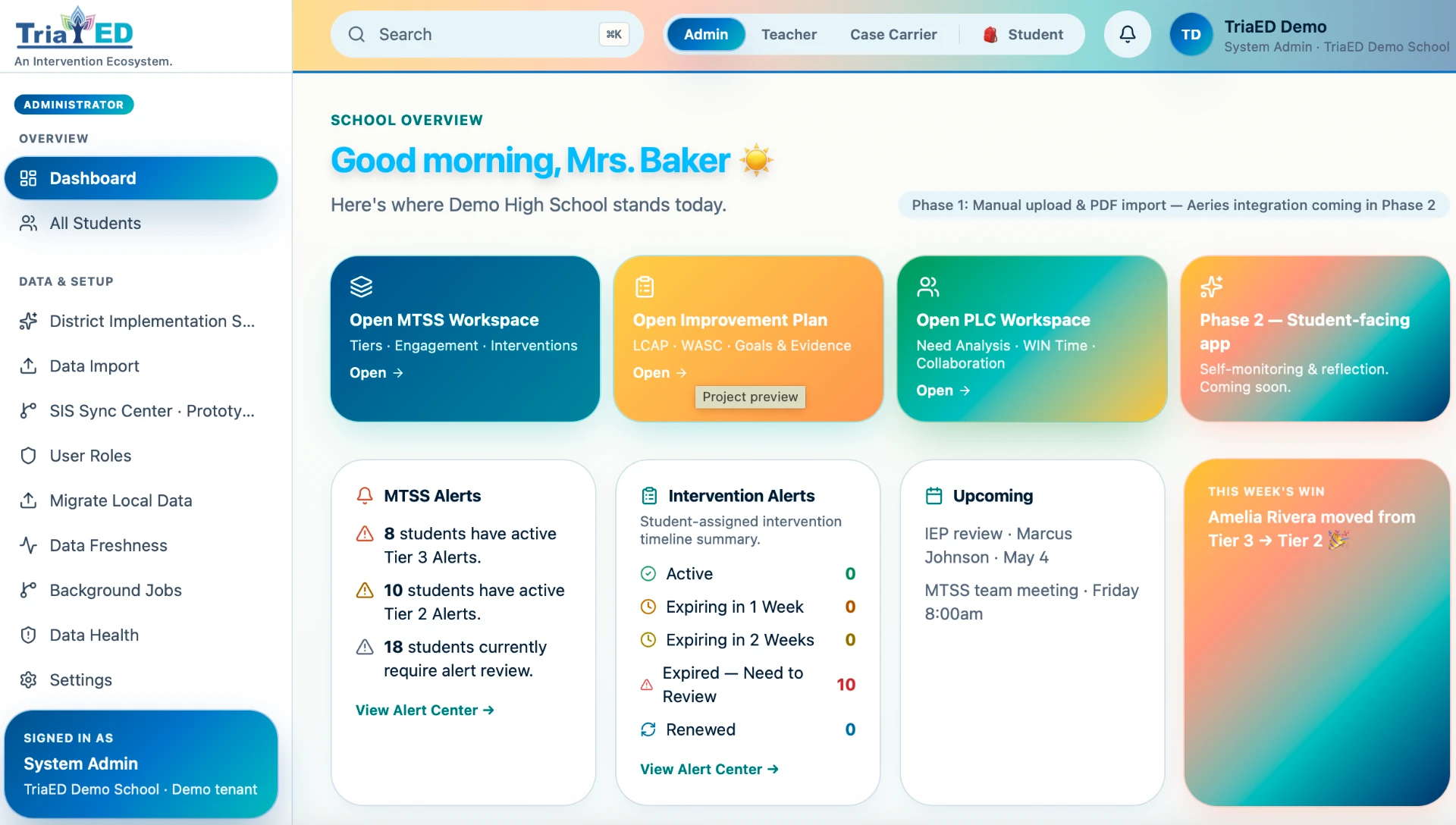
Product views on this site are captured from the TriaED build using fictional demo data. No real student information appears anywhere on this site.
The problem
Districts do not lack data, plans, or committed educators. What breaks is the connection between them: the plan lives in one system, the evidence in another, and the follow-through in somebody's inbox.
When plans are written without measurable targets, there is no way to know if student outcomes actually improved.
Improvement plans are widely written and unevenly felt in classrooms — most teachers do not see the connection.
Districts talk about collaboration and transparency constantly — but rarely give teams the tools to actually do it.
Each of these patterns is documented in published research. See the evidence and citations.
From Data to Action
TriaED is built around a repeating cycle. Each stage hands something specific to the next — and to a named role — instead of ending in a report.
Stage 1 of 6
Academic, attendance, behavior, and engagement signals arrive in one student view instead of five disconnected reports.
The cycle repeats. Each pass should leave the team with better information and a clearer owner for the next step.
Academic, attendance, behavior, and engagement signals arrive in one student view instead of five disconnected reports.
Patterns surface as a specific, named need — not a color on a spreadsheet nobody owns.
MTSS teams, PLCs, case carriers, and teachers work from the same evidence and the same agreed next step.
Interventions, Tier 1 instruction, accommodations, and assignments are assigned to a responsible role with a start date.
Progress monitoring and classroom evidence are captured against the goal that prompted the action.
What worked feeds back into improvement plans, PLC decisions, and the next cycle of support.
The platform
MTSS, PLC work, IEP goals, instruction, improvement planning, and engagement operate on the same information — which is what makes follow-through possible.
Tiered supports, referral to action, intervention assignment, and follow-through visible to the whole team.
Shared assessment workflows so teams analyze the same evidence and agree on next instructional moves.
Goal development, service and accommodation information, and progress evidence in one caseload view.
Standards-aligned lessons, instructional steps, UDL adjustments, and assignments generated from the plan.
Built for four roles
Admins, teachers, case carriers, and students each get a view built for their work — and each view feeds the others.
See beyond the data—track actual follow-through, ownership, and daily impact.
From lesson design to evidence tracking—everything teachers need to support every student.
Bring compliance requirements and daily coordination into one unified caseload command center.
Give students clear ownership of their goals, schedules, and personal growth.
Evidence & impact
We cite published findings about the problem TriaED addresses.
California
A Stanford-led review reports that the median measurability score across more than 7,000 California LCAP goals was zero, only 7.9% included an explicit numeric target, and more than one-third were duplicated across agencies.
Susanna Loeb et al., Toward a Stronger Next Generation of California Education, 2026, p. 17
National — RAND
In RAND's nationally representative educator panels, 67% of principals and 44% of teachers agreed that their school improvement plan had led to changes in teaching practices.
Christopher Joseph Doss, Goke Akinniranye, and Katie Tosh, School Improvement Plans: Is There Room for Improvement?, RAND Corporation, 2020, p. 2
Next step
Tell us where coordination breaks down, and we will show you how TriaED will build the bridge.